Growing up with a mum you feel doesn’t really love you affects you in some pretty profound ways, but they’re not always easy to see at first.

In fact, you might not even realise how deep it runs until you’re older and trying to navigate relationships, self-worth, or even just everyday emotions. That early gap in nurturing leaves a mark, and it doesn’t just disappear with time. It can show up in subtle behaviours, thought patterns, or emotional reactions that seem disconnected until you trace them back. Here are 13 ways that kind of wound can follow you into adulthood.
1. You struggle to believe people actually care about you.

No matter how much reassurance you get, there’s always a quiet voice asking, “Do they really mean it?” You might constantly wait for the other shoe to drop or assume people will leave the moment you mess up. Even when people show up, it doesn’t always sink in.
This doesn’t mean you’re dramatic. It’s what happens when your first experience of love felt conditional or cold. If the person who was supposed to love you unconditionally didn’t, it makes sense that love feels fragile now, even when it’s real.
2. You second-guess your emotions constantly.

If you grew up feeling brushed off, criticised, or emotionally neglected, you probably learned not to trust your own reactions. Now, you might downplay how hurt you feel or wonder if you’re being “too much” whenever something bothers you. The emotional self-doubt doesn’t come out of nowhere. It usually starts with having your feelings minimised as a child. Learning to trust your emotions again as an adult takes time, but it starts by recognising they were always valid, even if no one treated them that way.
3. You chase approval from people who remind you of her.

Without realising it, you might be drawn to people who are cold, distant, or critical because something in you still wants to win that kind of love. You want to finally feel “good enough” to be chosen or cared for by someone who feels just out of reach.
It’s not because you enjoy being hurt. It’s because your nervous system is wired to chase the version of love you first knew. Breaking the cycle means recognising that your craving for approval doesn’t have to be your compass anymore. Love shouldn’t feel like a test.
4. You’re fiercely independent, but sometimes painfully so.

You might be the kind of person who doesn’t ask for help, who powers through everything alone, who never wants to “need” anyone. That strength looks admirable on the outside, but sometimes it’s coming from a place of emotional survival, not freedom.
If the person who was meant to nurture you didn’t, you probably learned to stop expecting care. Being self-sufficient became safer. But underneath that, there’s often a quiet exhaustion, and a longing to feel safe enough to let someone else show up for you.
5. You struggle to set boundaries without guilt.

Saying no, speaking up, or standing your ground might feel incredibly uncomfortable, even when you know it’s the right thing to do. You might worry people will think you’re cold, selfish, or ungrateful for protecting your peace.
This can often be traced back to a childhood where your needs weren’t respected. Maybe you were guilt-tripped, ignored, or punished for asserting yourself. So now, even as an adult, standing up for yourself feels risky, like love might be taken away if you do.
6. You avoid emotional closeness, even when you want it.

You might want connection deeply, but when someone starts to get too close, you pull away. It’s not that you don’t care; it’s that intimacy feels unsafe. Vulnerability stirs up discomfort, and part of you assumes closeness will eventually turn into hurt.
This fear doesn’t come out of nowhere. When the earliest form of love was inconsistent, controlling, or cold, getting close now can feel like a trap. The hard part is realising that pushing people away doesn’t actually protect you. It just keeps the old wound open.
7. You over-explain yourself all the time.

Whether it’s justifying how you feel, explaining why you said something, or trying to make sure no one’s upset with you, you might find yourself constantly explaining yourself. You want to be understood, but it often comes with anxiety.
This usually stems from growing up in an environment where you weren’t given the benefit of the doubt. If you had to defend your every move to avoid criticism or conflict, over-explaining becomes a default. It’s exhausting, and it’s not how you should have to live.
8. You downplay your achievements.

When someone compliments you, you brush it off. When you accomplish something, you quickly move on without celebrating. It’s like part of you doesn’t feel comfortable sitting in pride or letting yourself be seen in a positive light.
This can happen when praise was rare or came with strings attached. If your mother didn’t show pride in you—or worse, competed with you—it’s hard to let yourself fully own your success now. But you deserve to feel good about what you’ve built, even if no one ever clapped for you as a kid.
9. You don’t feel “at home” in your own body.

Growing up without warmth or comfort from a primary caregiver can make it hard to feel relaxed in your own skin. You might struggle with constant restlessness, self-criticism, or a vague feeling of not belonging, even with yourself. That feeling often comes from never being fully accepted or nurtured in early life. As an adult, reconnecting with your body and giving yourself care (instead of punishment) can slowly help you rebuild that missing sense of safety.
10. You minimise your pain compared to other people’s.

Even when you’re hurting, you might tell yourself, “Other people had it worse.” You push your emotions aside, convince yourself you’re being dramatic, or struggle to take your own experience seriously, especially when it involves your mum. This is a common defence when your pain wasn’t acknowledged growing up. But invalidating your own experience doesn’t help you heal; it just keeps you stuck in silence. Your pain is real. It doesn’t need to compete with anyone else’s to matter.
11. You overperform to earn love.
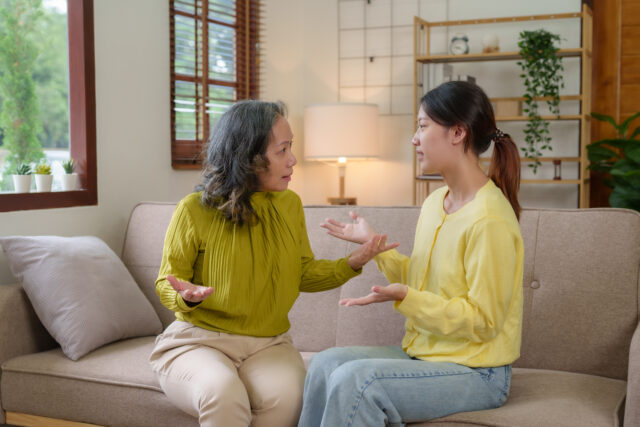
You might be the one who’s always trying to be the best friend, the best partner, the most helpful person in the room. Deep down, there’s often a quiet hope that if you do everything right, you’ll finally be loved the way you’ve always wanted to be.
This coping mechanism starts early because when love feels conditional, you learn to perform for it. Of course, love that needs to be earned over and over isn’t love that feeds you. Letting people in who value you without all the effort is uncomfortable at first, but it’s how healing starts.
12. You find it hard to comfort yourself.

When you’re upset, stressed, or overwhelmed, you might not know how to soothe yourself in a kind way. You might push through, numb out, or judge yourself instead. There’s a missing piece when it comes to self-compassion.
That’s often because you didn’t have a model of emotional comfort growing up. If no one taught you how to be gentle with yourself, you end up having to learn it in adulthood. It’s not your fault, but it is something you can give yourself now, little by little.
13. You’re still trying to figure out what “mother” is supposed to mean.

Even as an adult, you might feel confused when people talk about their close, nurturing relationships with their mum. You might feel a weird mix of envy, confusion, and grief, especially if you’ve spent years pretending it didn’t bother you.
That ache for a mother you never really had doesn’t just go away with age. But acknowledging it is a huge step. You don’t need to pretend it was fine. You’re allowed to feel hurt by what was missing, and still build something healthier for yourself going forward.